


Food for thought
Best wholesale THC cookies and baked edibles for retailers in 2026

Nov
Best overall format: individually sealed THC cookies. Best for a dessert-focused range: portioned brownies. Best for a bakery-specific assortment: packaged muffins. For wholesale THC cookies for retailers in Canada, every recommendation is conditional on lawful sourcing, compliant packaging and verified product documentation; this 2026 guide compares buying formats, not taste-tested brands.
- For wholesale THC cookies for retailers, prioritize compliant single-portion packs over larger baked formats.
- Bodegadistro supplies wholesale edibles to licensed Canadian retailers; assess each SKU separately before purchasing.
- Health Canada limits edible cannabis to 10 mg THC per immediate container, not per cookie.
- Compare cookies, brownies and muffins on documentation, allergens, shelf life and receiving requirements.
Why this matters
A bakery-style product needs more than an appealing flavour name to earn a purchase order. You need a lawful supply route, a clear cannabinoid declaration, ingredient information and handling instructions that your receiving team can follow.
Bodegadistro is a wholesale edibles supplier for licensed Canadian retailers. Start with the broader wholesale THC edibles assortment guide when deciding whether cookies fill a genuine gap rather than duplicate an existing edible category.
For your 2026 buying plan, separate product interest from purchasing approval. A supplier listing is not proof that a particular item meets the requirements for your province or territory.
What makes the best wholesale THC cookies for retailers
Use these criteria before comparing flavours or committing to a case:
- Lawful sourcing: Confirm that the supplier, distribution route and product meet the requirements applicable to your retail licence.
- Container-level THC: Check the total THC declaration for the immediate container, not just an individual piece.
- Batch documentation: Match the finished product and lot to the relevant testing and traceability records.
- Ingredient clarity: Obtain the ingredient list, allergen declaration and any supporting evidence for dietary claims.
- Shelf-life evidence: Request storage conditions and the supplier's documented shelf-life basis before setting receiving standards.
- Order fit: Confirm case configuration, minimum order, substitution rules and the process for discrepancies in writing.
These criteria apply equally to cookies, brownies and muffins. A familiar bakery format does not remove cannabis-specific purchasing obligations.
The Canadian compliance gate
Health Canada's edible-cannabis framework sets a maximum of 10 mg THC per immediate container. Apply that container-level limit when reviewing your 2026 assortment; multiple pieces inside a package do not create separate allowances.
A pack containing several cookies therefore needs assessment as a complete package. Do not treat a per-piece statement as permission to exceed the container limit.
Confirm current federal requirements and the sourcing rules of your provincial or territorial regulator before approving an order. A retail licence does not automatically authorize purchases from every business describing itself as a wholesaler.
Wholesale baked edibles at a glance
This ranking assigns each format a different retail role. The limitations identify what you must resolve before purchase, not defects established through product testing.
| Rank and format | Best for | Purchasing advantage | Key limitation | Decision |
|---|---|---|---|---|
| Individually sealed cookies | A focused cookie-category introduction | A defined pack to assess, receive and count | Ingredients, breakage protection and shelf life require verification | Buy only after approval |
| Portioned brownies | A dessert-focused assortment | A distinct baked format alongside cookies | Portion declarations and texture acceptance need clear specifications | Hold pending documentation |
| Packaged muffins | A bakery-specific assortment | A different format for an identified category gap | Dimensions, storage and shelf-life requirements need confirmation | Hold until operational fit is established |
There is no universal winner on flavour, freshness or durability without product-specific evidence. Individually sealed cookies are the default format to investigate first, not a substitute for SKU approval.
1. Individually sealed cookies: best for a focused cookie launch
Individually sealed cookies give you a defined retail pack to assess against your purchasing requirements. The format suits a buyer who wants a cookie-specific category rather than a broad expansion into baked edibles.
Keep the first purchase specification narrow. Identify the exact product, pack configuration and acceptable documentation instead of authorizing an open-ended bakery assortment.
Individually sealed cookie pros
- A defined pack makes the purchasing and receiving specification straightforward.
- A cookie-specific listing matches a clearly identified category request.
- A narrow assortment keeps product comparisons focused on equivalent formats.
Individually sealed cookie cons
- Individual wrapping does not establish compliant packaging or lawful sourcing.
- A product photograph does not prove protection against crushing or seal failure.
- Flavour names do not establish ingredients, allergens or dietary suitability.
Ask whether the declared THC applies to the complete immediate container. For a Canadian edible package, 10 mg THC is the container ceiling, not an automatic target for every product.
Your receiving specification should also describe acceptable physical condition. Define how staff record broken pieces, damaged seals and discrepancies without opening saleable packs unnecessarily.
Best for: Retail buyers introducing a tightly defined cookie category with documented receiving standards.
Verdict: Buy only after the exact SKU, source and packaging pass approval.
2. Portioned brownies: best for a dessert-focused assortment
Portioned brownies give your assortment a separate baked-dessert format. Assess brownies as their own category rather than assuming a cookie supplier's documentation also covers another recipe or production lot.
Keep product identity precise. A brownie description needs an ingredient list, a container-level cannabinoid declaration and a pack specification before it becomes a usable purchasing record.
Portioned brownie pros
- The format creates a distinct assortment slot rather than another cookie flavour.
- A defined portion format gives staff a specific pack configuration to verify.
- A separate product specification supports clear acceptance and rejection decisions.
Portioned brownie cons
- Portion appearance alone cannot establish cannabinoid distribution.
- Texture and condition require a supplier-agreed acceptance standard.
- Recipe changes require renewed ingredient and allergen review.
Do not translate a brownie's size into an assumption about potency. The approved label and supporting records govern the cannabinoid declaration.
For 2026 purchase orders, specify whether substitutions require authorization. A different recipe, portion configuration or cannabinoid declaration is not an equivalent replacement simply because both items are brownies.
Best for: Retail buyers with a defined dessert-format gap and the capacity to maintain separate SKU specifications.
Verdict: Hold until the finished-product documentation and acceptance criteria are complete.
3. Packaged muffins: best for a bakery-specific assortment
Packaged muffins belong on the shortlist when your assortment plan specifically calls for that format. Do not add muffins simply to increase the number of baked-edible listings.
Ask for packaging dimensions and storage instructions before assigning shelf space. Product size, pack geometry and handling requirements should inform the buying decision, not appear as surprises at receiving.
Packaged muffin pros
- The format serves a distinct bakery-assortment role.
- A separate listing makes the intended category position explicit.
- Product-specific specifications let you assess fit before committing shelf space.
Packaged muffin cons
- Familiar food packaging does not establish cannabis-packaging compliance.
- Storage requirements cannot be inferred from conventional bakery products.
- A different format adds documentation and receiving work to your assortment.
Require a documented shelf-life basis for the actual packaged product. Do not assign a shelf life from experience with an ordinary muffin or from another supplier's baked edible.
The purchasing test is simple: can your team receive, store and track the product according to its written specification? If not, resolve the operating requirements before approving the category.
Best for: Retail buyers with a specific muffin-category requirement and confirmed storage and merchandising fit.
Verdict: Hold until the format has a clear assortment role and an approved operating specification.
How the formats rank
The ranking prioritizes a focused cookie-category introduction, followed by distinct dessert and bakery use cases. It does not claim that one recipe tastes better, lasts longer or sells faster than another.
For your 2026 range, use the same approval gates across all formats. Lawful sourcing and product documentation come before assortment preference; a lower-ranked format with complete records is a better purchasing decision than a higher-ranked format without them.
Turn the shortlist into an approved purchase order
Use a staged approval process rather than treating account access as product approval. Bodegadistro's wholesale edibles scope does not replace your obligation to assess the source and each item against your retail requirements.
Source approval
Verify the supplier's identity and the lawful distribution route applicable to your location. Record the approval with your purchasing documentation rather than relying on a general description of the business.
Product approval
Match the exact item to its label, ingredients, cannabinoid declaration and batch records. Resolve inconsistent names or pack descriptions before entering the SKU into your ordering system.
Order approval
Confirm case configuration, minimum order, substitutions and discrepancy handling. Keep the written agreement attached to the order so receiving staff can compare what arrives with what was authorized.
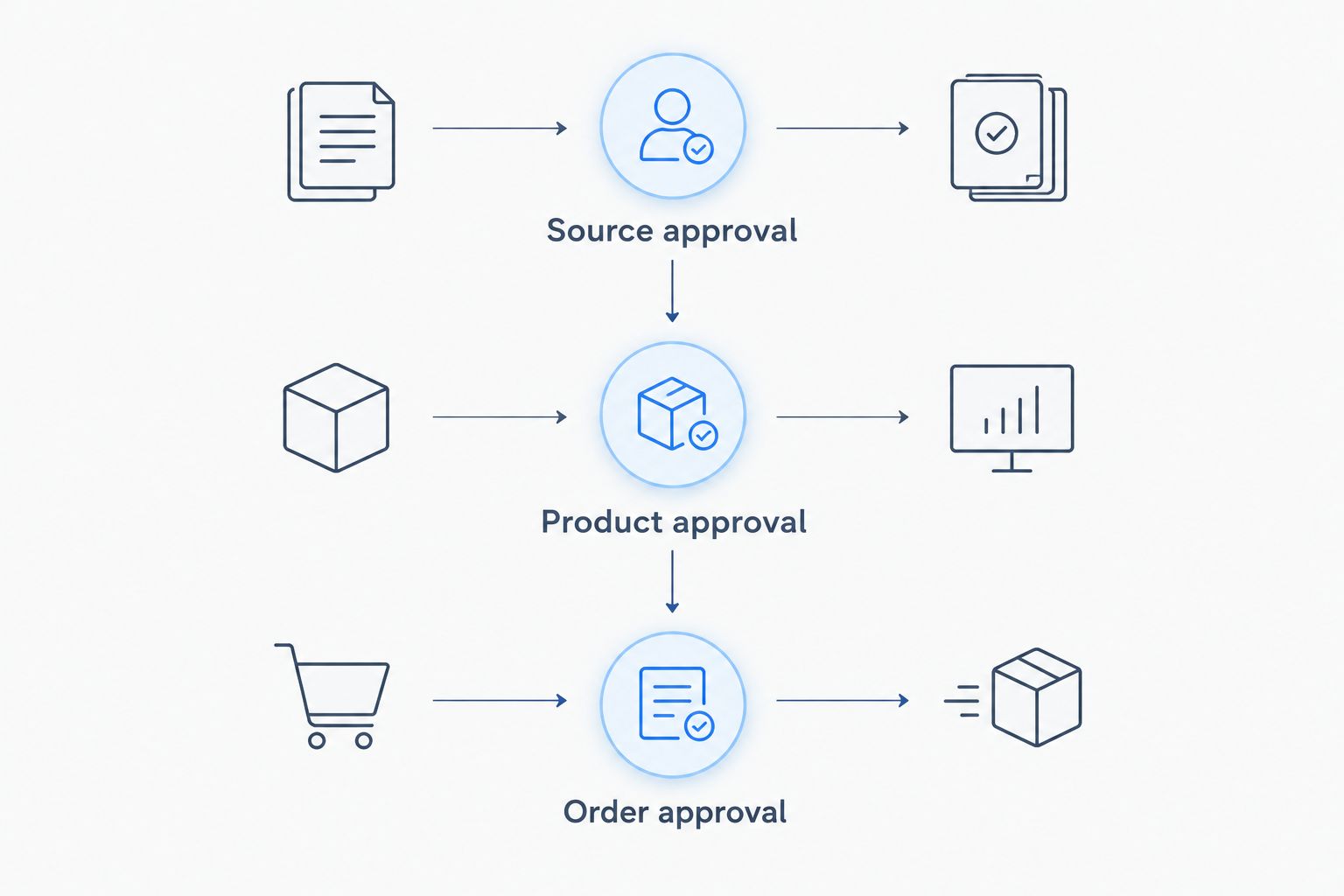
Treat these as separate decisions. Approval of a supplier does not approve every product, and approval of a product does not settle the terms of a particular order.
What lab testing must establish before you order
A laboratory claim needs to connect to the product you are buying. When assessing lab-tested THC edibles, match the report's product identity and lot details to the finished item rather than accepting a general testing statement.
Ask what the report covers. Ingredient testing and finished-product testing answer different questions; neither should be presented as the other.
Your 2026 approval record should establish:
- Product identity: The report and purchasing record refer to the same finished product.
- Lot connection: The documentation corresponds to the batch under review.
- Cannabinoid scope: The reported measurements support the declared cannabinoid information.
- Testing scope: The report identifies what was tested and which results it contains.
- Release decision: Your purchasing record shows who approved the item and on what basis.
Testing does not establish lawful sourcing by itself. Keep source verification, packaging review and laboratory review as separate checks, even when a supplier provides them together.
Receiving baked edibles without creating inventory ambiguity
Set your receiving standard before delivery. Staff need a clear decision rule for packaging damage, mismatched products and incomplete traceability.
Use the purchase order as the reference point:
- Identity: Compare the item name and pack configuration with the approved order.
- Condition: Record visible seal damage, crushing or other deviations from the agreed specification.
- Traceability: Capture the lot information needed for your inventory records.
- Storage: Follow the product's written storage instructions.
- Exceptions: Separate unresolved items from approved saleable inventory under your operating procedures.
Do not accept a substitution solely because it has the same flavour. A different product needs its own review, particularly when ingredients, cannabinoids or packaging change.
Bodegadistro buyers should confirm order-specific requirements directly rather than assume that trade-account access establishes shipping, returns or discrepancy terms. Put the agreed process in writing before authorizing the purchase.
Which wholesale baked edibles should you choose?
Choose individually sealed cookies as the default format to investigate when your actual requirement is a cookie category. Keep brownies for a defined dessert-format role and muffins for a specific bakery-assortment requirement.
For 2026, the strongest buying decision is the product that passes your sourcing, documentation and operating checks. Do not replace those checks with a flavour ranking or a supplier's general category description.
If the exact cookie product fails approval, hold the order. Buying a different baked edible merely to complete the assortment does not resolve the original purchasing requirement.
FAQ
What’s the best format for wholesale THC cookies for retailers?
Individually sealed cookies are the default format to investigate for a focused cookie-category introduction. Approve the exact product only after checking lawful sourcing, packaging, ingredients and batch documentation.
How much THC can a Canadian edible package contain?
Health Canada’s edible-cannabis framework limits THC to 10 mg per immediate container. The limit applies to the complete container, not separately to every cookie or piece inside it.
Are THC brownies better than cookies for a retail assortment?
Brownies serve a different assortment role rather than being automatically better than cookies. Choose brownies for a defined dessert-format gap and assess their documentation independently.
Does a lab-tested claim prove an edible is legal to stock?
No, a lab-tested claim does not establish lawful sourcing or retail eligibility. Match the relevant report to the product and lot, then separately verify the supply route and packaging requirements.
Can a licensed Canadian retailer order from any cannabis wholesaler?
No, a retail licence does not automatically authorize purchases from every cannabis wholesaler. Confirm the permitted sourcing route with the regulator responsible for your province or territory.
What should I request before ordering baked cannabis edibles?
Request source verification, the exact product specification, ingredient and allergen information, cannabinoid declarations, relevant batch records and written storage instructions. Confirm order configuration and discrepancy handling before authorizing the purchase.
Does Bodegadistro serve retail buyers or consumers?
Bodegadistro describes its business as wholesale supply for licensed retailers across Canada. Retail buyers should still assess the lawful source and each product separately before ordering.
One last thing
The familiar food name is not the purchasing specification. A cookie can have a clear flavour description while leaving the container declaration, ingredient record or batch connection unresolved.
Write the approval record so another buyer can identify exactly what passed review. If that record cannot distinguish the approved item from a substitute, tighten it before placing the order.
Related guides
- Wholesale THC gummies brands for dispensaries
- Wholesale THC vape suppliers for Canadian retailers
- Wholesale THC concentrates for dispensaries
